
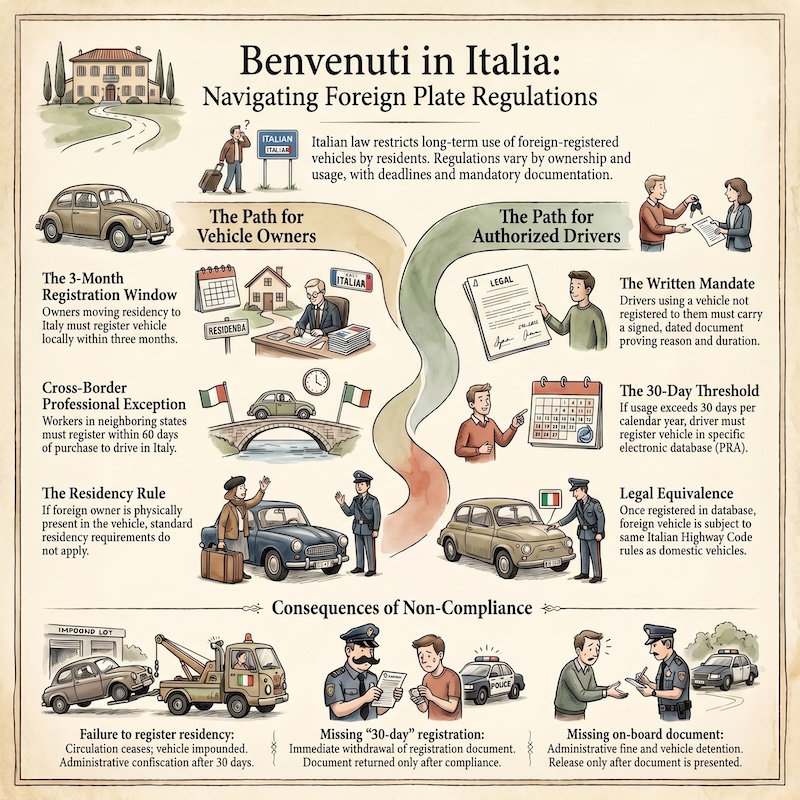
A vehicle registered abroad may circulate in Italy, but when the owner transfers their official residence to Italy, they cannot continue to use that vehicle indefinitely with foreign plates. As a general rule, if the vehicle belongs to a person who has become resident in Italy, it may circulate in Italy only for a limited period. Within three months from acquiring residence in Italy, the vehicle must be registered in Italy according to the ordinary rules that apply to Italian vehicles. This means that changing residence also creates an obligation to regularize the legal status of the vehicle.
When a person residing in Italy drives a vehicle registered abroad that is not registered in their own name, there must be a document kept on board. This document must be signed by the registered holder of the vehicle and must have a certain date. It must show why the driver is allowed to use the vehicle and for how long. In practice, it is not enough to say that permission was given. There must be written proof showing the legal basis for using the vehicle, such as a loan, company use, free use arrangement, or another lawful relationship, together with the duration of that availability.
If the vehicle is available to a person resident in Italy or to a company based in Italy for more than thirty days in a calendar year, even if those days are not consecutive, having the document on board is no longer enough by itself. In that case, the legal basis and duration of the vehicle’s availability must also be registered in a special electronic list connected to the Public Vehicle Register. The obligation to register falls on the user of the vehicle. If the conditions later change, for example if the period changes or the vehicle is made available to someone else, those changes must also be recorded within three days. The same applies if the person’s residence or the company’s registered office changes.
If the required document is missing from the vehicle or registration has not been carried out when it was required, the law assumes that the vehicle is available to the driver. In that situation, the driver is treated as directly responsible for fulfilling the obligation to regularize the position of the vehicle. In addition, for the entire time in which the vehicle is recorded in the special list, the same Highway Code rules that apply to vehicles registered in Italy also apply to the foreign vehicle. This means that, for circulation purposes, a foreign vehicle recorded in that list is treated in a way that is largely equivalent to an Italian vehicle.
The same rules also apply to employees and self-employed persons who work professionally in a neighboring or bordering State and use vehicles registered there in their own name. In this situation there is an obligation to register the vehicle’s availability within sixty days from acquiring ownership. Once registration has been completed, the vehicle may also be driven by family members living with those persons, provided those family members reside in Italy.
The number plates of foreign vehicles must always be clearly readable and must contain a registration sign composed of Arabic numerals and uppercase Latin letters. If the plate does not satisfy those requirements of readability or format, the penalties provided for irregular number plates apply.
There are, however, important exceptions. These rules do not apply to residents of the municipality of Campione d’Italia, nor to certain categories of civilian or military personnel serving abroad for public administrations, nor to their cohabiting family members living abroad. The rules on registration in Italy or on documentation of vehicle availability also do not apply when the owner of the vehicle, who resides abroad, is present on board. There is also a special rule for persons residing in Italy who drive vehicles registered in the Republic of San Marino and made available by companies established in San Marino, when there is an employment relationship or continuous collaboration with those companies.
If an owner allows the vehicle to circulate in violation of the rules requiring Italian registration or registration of the vehicle’s availability, an administrative penalty applies. In such cases the authority withdraws the circulation document, orders the person to regularize the situation, and requires the immediate end of circulation. The vehicle is then removed and stored in a place not open to public traffic. It is returned only once compliance with the imposed obligation has been proven. As an alternative, the holder of the foreign registration document may ask to be authorized to leave Italy by the shortest route. However, if within thirty days the vehicle is not registered in Italy, is not recorded where required, or does not leave the country when authorized to do so, administrative confiscation is imposed. Driving the vehicle during the seizure period or in breach of the conditions imposed for leaving the country leads to further penalties.
If the only problem is the absence of the document proving the legal basis and duration of availability of the vehicle, a specific administrative penalty applies. The report will require the document to be produced within thirty days. The vehicle is placed under administrative detention and is returned only after the document is shown or, in any case, after the time period laid down by law has passed. If the document is not produced, further penalties apply.
When the vehicle should have been registered in the special electronic list but that was not done, or when later changes or changes of residence or headquarters were not reported, the violation is more serious. In that case a substantial administrative fine applies and the circulation document is withdrawn immediately. The document is returned only after the missing obligations have been fulfilled. If the vehicle continues to circulate while the document has been withdrawn, further penalties apply.
In summary, the key point to remember is that a person residing in Italy cannot make stable use of a foreign-plated vehicle without following specific legal rules. Depending on the case, it may be necessary to register the vehicle in Italy, keep on board a document proving the right to use it, or officially record the vehicle’s availability. The purpose of the rule is to prevent fictitious use of foreign vehicles and to ensure transparency about who actually has the vehicle and who is responsible for it.
Studied the theory? Test yourself with 7,000+ official Italian Ministry questions.
📝 Start now with SuperQuizPatente