
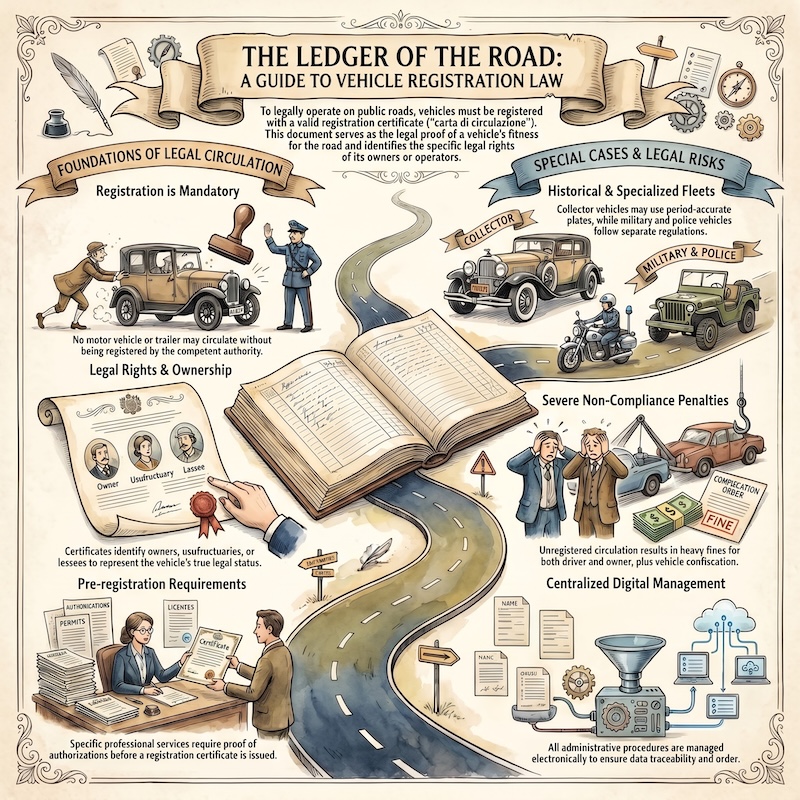
To drive legally on the road, motor vehicles, motorcycles, and trailers must be registered and must have a registration document. In other words, a vehicle cannot be used freely on public roads unless it has been officially registered with the competent authority and has the document proving that it is authorized for circulation. Registration is therefore an essential requirement for lawful use of the vehicle.
The registration document is issued by the competent office in the name of the person who declares themselves to be the owner of the vehicle. In some situations, however, the document may also show other persons who have a legal interest in the vehicle, such as a usufruct holder, a leasing user with option to purchase, or a seller in the case of a sale with retention of ownership. This ensures that the legal status of the vehicle is accurately represented.
The registration document is not issued automatically in every case. When the law requires specific authorizations or qualifications for using a vehicle in a certain service or transport activity, those requirements must already be met. For example, if a vehicle is intended for a professional transport activity, the person using it must prove that they have the necessary legal title or authorization. Without these requirements, the vehicle cannot be properly registered for that use.
The Ministry of Transport establishes the procedures for registration and determines the contents of the registration document. In the case of trailers, for example, the document may include information needed to allow lawful towing. For vehicles entered in the public vehicle register, the registration document also contains data concerning ownership and the legal status of the vehicle.
Exceptional vehicles and certain other special vehicles do not receive an ordinary registration document but a special one. The same applies, in specific cases, to some agricultural machines. This means that not all vehicles follow exactly the same formalities, because some categories are subject to special rules.
Historic and collectible vehicles are subject to specific rules. Their registration requires proof of ownership and a technical certificate confirming the vehicle’s characteristics. In certain cases, when such a vehicle is registered again, the applicant may obtain the original plate and original registration document from its first registration, or a historical plate corresponding to the period in which the vehicle was built or used, provided that the chosen alphanumeric combination is not already assigned to another vehicle still in circulation. This rule is intended to preserve the vehicle’s historical identity.
Anyone driving a vehicle for which no registration document has been issued commits a serious violation. In this case, an administrative fine applies both to the driver and separately to the owner or to the person holding an equivalent legal right over the vehicle, such as the usufruct holder, leasing user with option to purchase, or buyer under retention of ownership. In addition to the fine, the vehicle may be confiscated. This shows how important it is for a vehicle to be properly registered and documented before it is used on the road.
Driving with a trailer attached to a towing vehicle whose registration document does not indicate, where required, the necessary towing characteristics is also a violation. In practical terms, the document must correctly show that the towing vehicle is suitable for pulling that type of trailer. If that information is missing when it is required, a penalty applies.
The ordinary registration rules do not apply to vehicles of the armed forces and certain equivalent public bodies, because they are subject to special regulations. Vehicles used exclusively for road policing services are also registered under special procedures, and their registration document must clearly state that they are intended only for that purpose.
Finally, the administrative procedures relating to registration and other related legal formalities are handled electronically by the competent offices. This means the system is organized to make the management of vehicle documents and data more efficient, centralized, and traceable.
Studied the theory? Test yourself with 7,000+ official Italian Ministry questions.
📝 Start now with SuperQuizPatente