
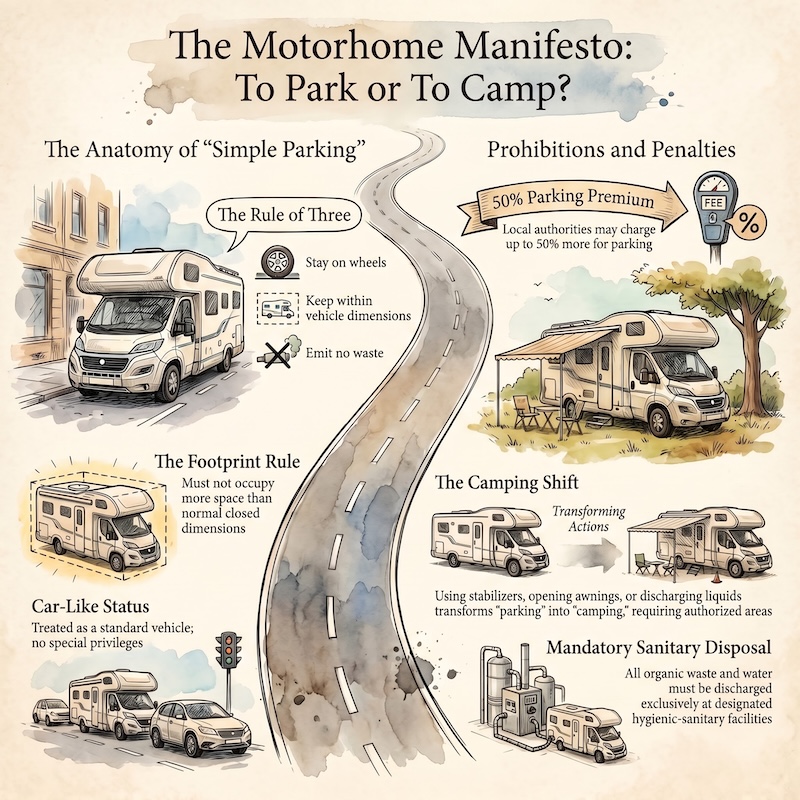
Motor caravans, commonly known as campers, are treated like any other vehicle in terms of road circulation. This means they must follow the same rules, restrictions, and prohibitions as other vehicles, without any special privileges on the road.
Regarding parking, the law clearly distinguishes between parking and camping. Simple parking is allowed wherever parking is permitted, provided certain conditions are met. The vehicle must rest only on its wheels, must not occupy more space than its normal dimensions, and must not release any fluids outside, except those related to the engine’s operation. If these conditions are respected, the situation is considered normal parking, not camping.
If the camper uses stabilizers, opens awnings, releases waste, or takes up more space than allowed, it is considered camping and may be prohibited outside designated areas.
In paid parking areas, motor caravans may be charged up to 50% more than standard cars, depending on local regulations.
A key aspect concerns waste disposal. It is strictly forbidden to discharge organic waste or wastewater (both clean and dirty water) onto roads or public areas. Disposal must take place only in designated sanitary facilities. This rule also applies to other vehicles equipped with internal waste collection systems.
Violations of these rules result in administrative penalties. Authorities also provide dedicated service areas along roads and campsites for proper waste disposal and regulate the chemical substances used in waste treatment.
For theory exam preparation, it is important to remember that campers are not free to behave like mobile homes everywhere: they can park like a car only if they do not extend beyond the vehicle and do not impact the environment or traffic.
Studied the theory? Test yourself with 7,000+ official Italian Ministry questions.
📝 Start now with SuperQuizPatente