
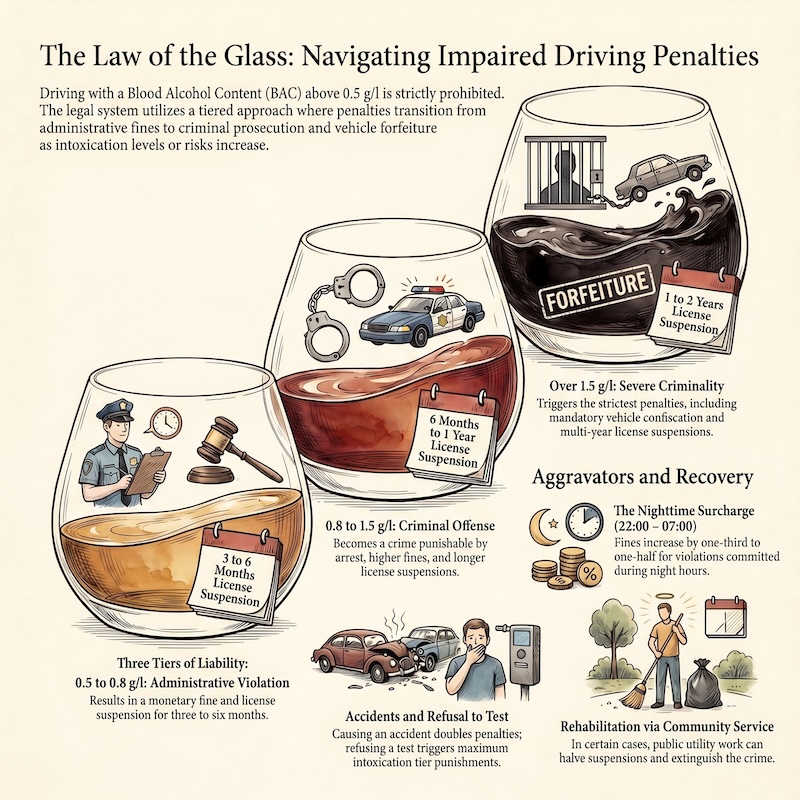
Driving after drinking alcohol is prohibited. The law considers drink driving very serious because alcohol reduces attention, slows reflexes, alters the perception of distance, and increases the risk of accidents. For this reason, the road code distinguishes different levels of seriousness according to the blood alcohol level that is found.
If the blood alcohol level is above 0.5 grams per litre and does not exceed 0.8 grams per litre, an administrative fine applies together with suspension of the driving licence from three to six months. If the blood alcohol level is above 0.8 grams per litre and does not exceed 1.5 grams per litre, the conduct becomes a criminal offence and leads to a fine, possible arrest of up to six months, and suspension of the licence from six months to one year. If the blood alcohol level is higher than 1.5 grams per litre, the violation is even more serious. In that case the driver faces a higher fine, arrest from six months to one year, and suspension of the licence from one to two years. In the event of a repeated offence within two years, the licence is always revoked. In addition, after conviction, confiscation of the vehicle is normally ordered unless the vehicle belongs to someone not involved in the offence.
If a drunk driver causes a road accident, the penalties become more severe. In that case the penalties for drink driving are doubled and the vehicle is also subject to administrative detention for one hundred and eighty days, unless it belongs to a person unrelated to the offence. When, in addition to the accident, the driver is found to have a blood alcohol level above 1.5 grams per litre, the licence is always revoked.
The law also provides an aggravating circumstance for offences committed at night. If the offence is committed between 10 p.m. and 7 a.m., the fine is increased by one third to one half. This is because the risk of alcohol-related accidents is considered even higher during night hours.
To check whether a driver has been drinking, the police may carry out preliminary non-invasive checks or tests using portable devices. If these checks are positive, if there has been an accident, or if there are other reasons to believe that the driver is affected by alcohol, the police may carry out the formal test using the instruments provided by law. If the driver has been involved in an accident and is receiving medical treatment, the blood alcohol level may also be checked by a health facility at the request of the police.
Refusing to undergo the test is very serious. Refusal is punished in the same way as the highest category of drink driving. This means the driver risks the same penalties as a person driving with a blood alcohol level above 1.5 grams per litre, including suspension of the licence, possible confiscation of the vehicle, and, in case of repeated offending, revocation of the licence.
When licence suspension is imposed for drink driving, the prefect also orders a medical examination to verify the driver’s physical and psychological fitness. If the driver does not attend the medical examination within the prescribed time, the licence may remain suspended until the examination is completed. If the blood alcohol level found is above 1.5 grams per litre, the prefect may also impose a precautionary suspension of the licence until the medical examination is completed.
In some cases, outside the situation where an accident has been caused, the custodial and financial penalties may be replaced by community service. If it is completed successfully, the offence may be declared extinguished, the licence suspension is reduced by half, and confiscation of the vehicle may be revoked. However, this possibility may be granted only once.
For more serious convictions, namely where the blood alcohol level is above 0.8 grams per litre, special restrictions are added to the Italian driving licence. In practice, for a certain period the driver may be authorized to drive only without consuming alcohol and only vehicles equipped with devices that prevent the vehicle from starting if alcohol is detected. If the driver breaches the rules again during that period, the penalties increase. They become even more severe if the installed device is altered or tampered with.
For theory exam preparation, it is important to remember a few basic points. Driving with a blood alcohol level above 0.5 grams per litre is prohibited. The higher the alcohol level, the more serious the consequences. If an accident is caused or the driver refuses testing, the situation becomes much worse. Drink driving is not just a simple traffic offence. In the more serious cases it is a crime with serious consequences for the licence, the vehicle, and personal freedom.
Studied the theory? Test yourself with 7,000+ official Italian Ministry questions.
📝 Start now with SuperQuizPatente