
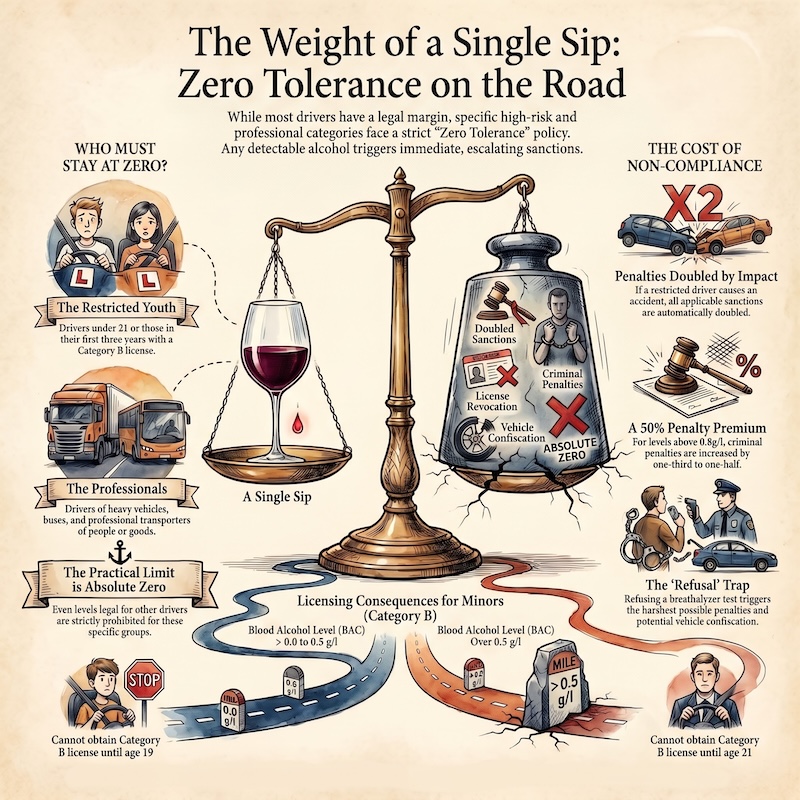
For some categories of drivers, the law imposes an even stricter rule than the general rule on drink driving: it is not allowed to drive after drinking alcohol, even if the blood alcohol level is very low. In these cases, the practical limit is zero. This rule applies to drivers under twenty-one years of age, drivers in the first three years after obtaining a category B licence, drivers who professionally transport people or goods, and drivers of heavy vehicles, buses, articulated vehicles, and vehicle combinations exceeding certain weight limits.
For these persons, a blood alcohol level above zero and up to 0.5 grams per litre is enough to trigger an administrative penalty. This means that even an amount of alcohol which, for other drivers, would not yet fall within the punishable range under article 186 is already forbidden for these categories. If, in this situation, the driver also causes an accident, the penalty is doubled.
If the blood alcohol level is above 0.5 grams per litre, the rules of article 186 also apply to these special categories, but with harsher penalties. When the driver falls within the range between 0.5 and 0.8 grams per litre, the penalties are increased by one third. When the blood alcohol level exceeds 0.8 grams per litre, therefore in the more serious ranges, the penalties provided for drink driving increase by one third to one half. This shows that the law requires an even higher level of caution from young drivers, newly licensed drivers, and professional drivers.
For some categories, the consequences can be even more severe. If a driver of particularly heavy vehicles or vehicles used for collective passenger transport is found with a blood alcohol level above 1.5 grams per litre, the driving licence is always revoked. For the other drivers belonging to these special categories, the licence is always revoked in case of repeat offending within three years. In addition, the other more serious consequences provided for by article 186 still apply.
Also for these categories, the police may carry out preliminary checks and formal tests using the instruments provided by law. If the driver refuses to undergo testing, the situation is very serious. The penalties for the most serious category under article 186 apply, increased by one third to one half. The conviction also leads to licence suspension, possible confiscation of the vehicle, and, in the cases provided by law, revocation of the licence. If the vehicle belongs to a person unrelated to the offence, the suspension of the licence is doubled.
Together with the suspension of the licence, the prefect also orders a medical examination to verify the driver’s physical and psychological fitness. This rule exists to check whether the person can still drive safely after the offence committed.
The law provides a special consequence for drivers under eighteen years of age. If a minor is found with a blood alcohol level above zero and not exceeding 0.5 grams per litre, they may not obtain a category B licence before the age of nineteen. If the blood alcohol level exceeds 0.5 grams per litre, they may not obtain a category B licence before the age of twenty-one. This is therefore a very serious consequence because it directly affects the future possibility of obtaining a driving licence.
For theory exam preparation, it is essential to remember that for young drivers, newly licensed drivers, and professional drivers, the rule is zero alcohol. Even a very small amount of alcohol can lead to penalties. If the blood alcohol level rises, the penalties become more severe than the ordinary ones. In the event of an accident, refusal of testing, or repeat offending, the consequences for the driving licence become particularly serious.
Studied the theory? Test yourself with 7,000+ official Italian Ministry questions.
📝 Start now with SuperQuizPatente