
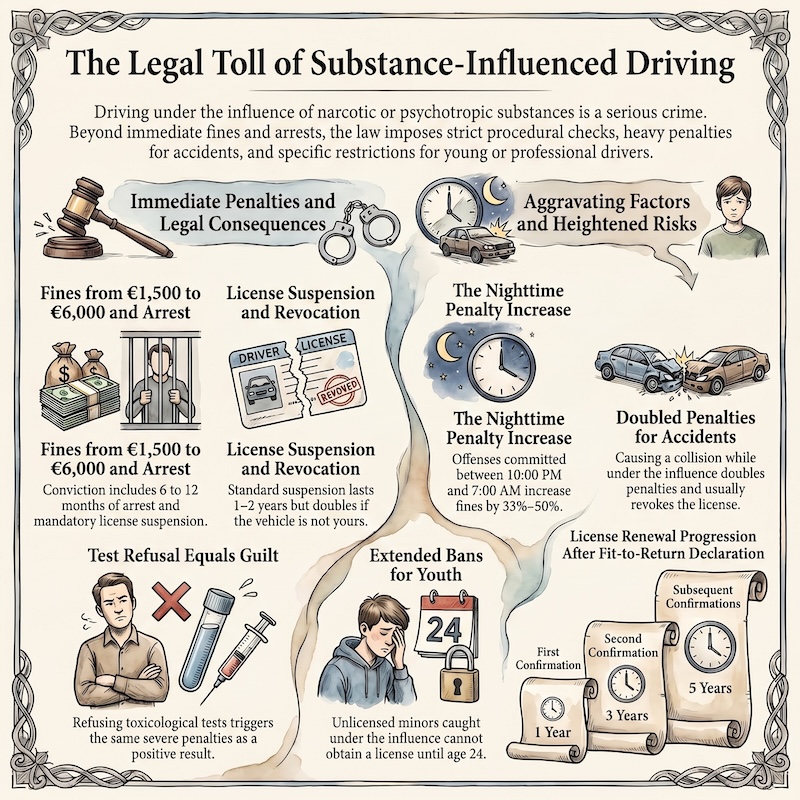
Driving after taking narcotic or psychotropic substances is a criminal offence. What matters is not only obvious visible impairment. The law punishes a person who drives after using these substances when the required checks confirm their presence according to legal procedures. The consequences are very serious: a fine from 1,500 to 6,000 euros, arrest from six months to one year, and suspension of the driving licence from one to two years. If the vehicle belongs to someone unrelated to the offence, the licence suspension is doubled. For some categories of drivers subject to stricter rules, such as those referred to in Article 186-bis, the penalties increase even more. In the case of a repeated offence within three years, or in some particularly serious cases involving specific categories of drivers, the licence is revoked.
If a driver under the effect resulting from drug use causes a road accident, the consequences become even more severe. The criminal penalties are doubled and, as a rule, the driving licence is always revoked. This means that drug driving is not only a serious violation, but a behaviour considered extremely dangerous because it directly threatens road safety and may have heavy personal and professional consequences.
The law also provides an aggravating circumstance linked to time. If the offence is committed at night, between 10 p.m. and 7 a.m., the fine is increased by one third to one half. For theory exam purposes, it is important to remember that driving after taking drugs is considered especially serious because of the high risk of accidents, particularly during night hours.
Police checks may begin with preliminary roadside controls. Road police officers may subject the driver to non-invasive qualitative checks or portable device tests, while respecting privacy and without harming the person’s physical integrity. If these first checks are positive, or if there is otherwise reasonable ground to believe that the driver is under the effect of narcotic or psychotropic substances, the police may order more precise toxicological tests on oral fluid samples. These tests must follow technical rules and be carried out by certified laboratories.
If it is not possible to take an oral fluid sample, or if the driver refuses that sampling, the police escort the person to a public, accredited, or otherwise suitable medical facility in order to collect biological samples and carry out the necessary tests. The same procedure may also apply in the event of a road accident, as far as compatible with rescue operations and accident investigations. If an injured person involved in an accident is already receiving medical treatment, the health facility may perform the required tests during treatment. These examinations may also check blood alcohol at the same time.
Health facilities issue a certificate with the results to the police, while respecting privacy rules, and the necessary information is sent to the competent authorities. If the final results are not immediately available but the first roadside screening is positive, the police may immediately withdraw the driving licence until the test results arrive, for a maximum period of ten days, and stop the driver from continuing the journey. If no other suitable person is available to drive the vehicle, it is transported to a place indicated by the driver or to the nearest garage, and all transport and recovery costs are paid by the checked driver.
If for any reason it is impossible to complete the later tests, but the preliminary roadside check is positive, the police may still immediately stop the driver from continuing to drive. In that case, the Prefect may order a compulsory medical examination to assess fitness to drive. If that medical examination finds the person unfit, the licence is revoked, and a new one cannot be obtained before three years have passed from the revocation decision. When analytical or medical tests confirm that the person drove after taking drugs, the Prefect must in any case order the medical examination and precautionarily suspend the licence until the review is completed. Again, if the driver is found unfit, the licence is revoked and cannot be obtained again for at least three years.
Young drivers face even stricter consequences. If the offence is established against a person under twenty-one who does not yet hold a driving licence, that person cannot obtain one before the age of twenty-four. A similar rule applies to someone who at the time only held a learner’s permit: the permit can also be affected by the same suspension or revocation measures, and a new learner’s permit cannot be obtained before the age of twenty-four. If the offence is committed by a person who has no driving licence at all, instead of suspension or revocation there is a ban on obtaining one for a certain period. This period may range from one to two years, may correspond to the normal suspension period, or in the most serious cases may last three years.
Another very important study point is refusal to undergo the tests. Refusing the checks does not help the driver avoid consequences. On the contrary, refusal leads to very severe penalties, through the rules that apply to refusal of alcohol testing. In addition, the Prefect orders a medical examination and precautionary suspension of the licence until the review procedure is completed. For the theory exam, it is useful to remember this basic principle: refusing the test is itself treated as a very serious matter.
Even when the driver is later considered fit again, the validity of the licence may still be limited. After the required medical examination, the renewed licence may be valid for no more than one year at first, then no more than three years at the next confirmation, and no more than five years at later confirmations. The aim is to maintain closer control over the driver’s condition.
In some cases, the law allows imprisonment and the financial penalty to be replaced with community service, provided the case is not one of the excluded situations, such as those involving a road accident under this rule. Community service consists of unpaid work for the benefit of the community, especially in the field of road safety and road education, and may also include a therapeutic and social rehabilitation programme for a drug-dependent person. If the programme is completed successfully, the judge declares the offence extinguished, reduces the licence suspension by half, and cancels the confiscation of the seized vehicle. If the obligations are violated, the benefit is revoked and the original punishment, licence suspension, and confiscation apply again. This replacement may be granted only once.
Finally, it is important to remember that after conviction, or after a plea-based sentence, confiscation of the vehicle used to commit the offence is generally ordered, unless the vehicle belongs to a person unrelated to the offence. In practice, driving after taking narcotic or psychotropic substances does not mean only a fine or a temporary licence suspension. It can lead to arrest, loss of the vehicle, revocation of the licence, and a long ban on obtaining a new one.
Studied the theory? Test yourself with 7,000+ official Italian Ministry questions.
📝 Start now with SuperQuizPatente