
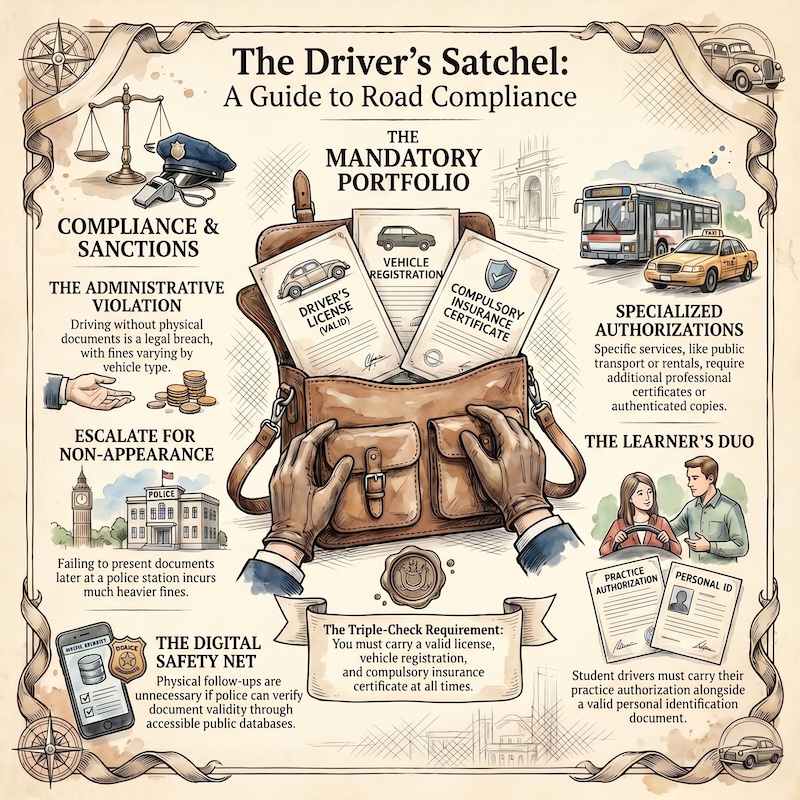
In order to drive legally with a motor vehicle, the driver must carry the documents required both for driving and for the circulation of the vehicle. First of all, the driver must have the vehicle circulation document required for that type of vehicle, such as the registration certificate or equivalent document. The driver must also have a valid driving licence for the category of vehicle being driven. If that licence also requires a specific certificate relating to physical or mental fitness, that certificate must also be available.
If the driver is carrying out driving practice, instead of a full driving licence they must carry the learner authorization and a personal identification document. The person acting as instructor must also carry the required driving licence and, if they are a driving school instructor, they must also carry the professional qualification certificate required by law.
The driver must also carry proof of compulsory insurance. In addition, if the vehicle is being used for a particular purpose regulated by law, such as certain transports or special services, the corresponding licence or authorization must also be carried on board. The same applies when the vehicle is being used for a purpose different from the one shown in the registration document or when it is circulating for testing purposes. In such cases the specific authorization is required.
For certain vehicles or services, the law allows the original registration certificate to be replaced by a copy authenticated by the owner. This applies in specific situations provided by the rule, for example for certain heavy trailers, some public passenger transport vehicles, or vehicles rented without driver or under leasing arrangements. In these cases the copy must be properly authenticated by the owner with their signature.
When professional certificates, qualification cards, or certificates of fitness are required for driving or carrying out a specific transport activity, these must also be kept on board and shown when requested. In practice, the driver must always be able to prove not only that they are authorized to drive the vehicle, but also that the vehicle is authorized to circulate and is being used lawfully.
If the driver does not carry the required documents, this is an administrative offence. The penalty is lower for mopeds, but it still applies. In addition, if the authority orders the driver to appear later at a police office to provide information or show documents, and the driver fails to do so without valid reason, the penalty is much more serious. In that case, the penalty for not having the document that should have been shown may also be applied.
However, the law makes it clear that the obligation to appear later does not apply when the police can directly verify the existence and validity of the documents through databases or public records that are accessible to them, except where technical access is not possible at the time of the check.
For theory exam preparation, it is important to remember one simple principle: it is not enough to know how to drive. You must also always carry all the documents required for the vehicle, for driving, and for the specific use being made of the vehicle. Missing documents or failing to comply with an order to show them may lead to significant penalties.
Studied the theory? Test yourself with 7,000+ official Italian Ministry questions.
📝 Start now with SuperQuizPatente