
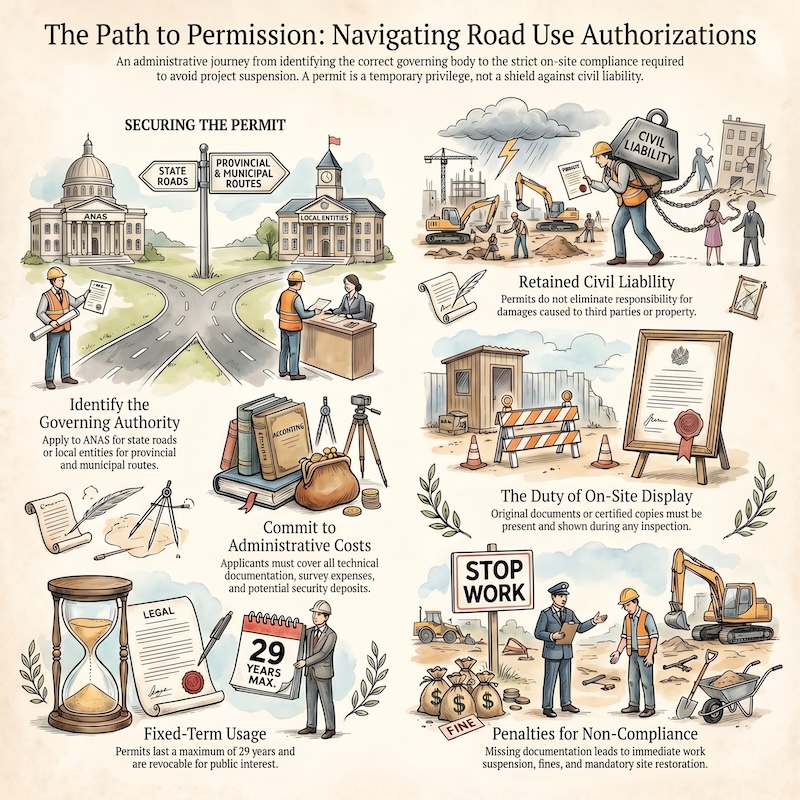
To obtain an authorization or concession for the use of a road, an application must be submitted to the competent authority. For state roads, the request must be submitted to the ANAS office or, in the case of concession roads, to the concessionaire, who may forward it with their opinion. For non-state roads, the application must be submitted directly to the road authority, such as the municipality, province, or region.
The application must include the required technical documentation and a commitment by the applicant to cover all related expenses, such as inspections and administrative processing costs. In some cases, a security deposit may also be required.
Authorizations and concessions are granted without prejudice to the rights of third parties. This means that the person receiving the permit remains responsible for any damage caused by the works, occupations, or deposits carried out on the road. In other words, the authorization does not remove civil liability.
Each authorization or concession specifies the technical and administrative conditions to be respected, the fee to be paid for the use of the road, and the duration of the permit. The duration cannot exceed 29 years, although permits can be renewed. However, the authority may revoke or modify the permit at any time for reasons of public interest or road safety, without any obligation to compensate.
In the case of road occupation for public services, the duration of the permit is linked to the time required to complete the works. The fee for using the road may be set as an annual payment or as a one-time amount.
The amount to be paid is determined based on factors such as the limitations imposed on the road, the economic value of the authorization, and the benefit obtained by the user.
Anyone carrying out works, occupations, or deposits on the road must always keep the authorization document (or a certified copy) at the work site and present it upon request by the authorities. This is a key obligation during inspections.
If the document is not presented, an administrative penalty applies. In addition, if the authorization is missing or cannot be shown, the works are suspended. If it is confirmed that no authorization exists, the suspension becomes final and the person responsible must restore the site at their own expense. For the theory exam, it is essential to remember that having an authorization is not enough—you must also be able to show it at any time.
Studied the theory? Test yourself with 7,000+ official Italian Ministry questions.
📝 Start now with SuperQuizPatente