
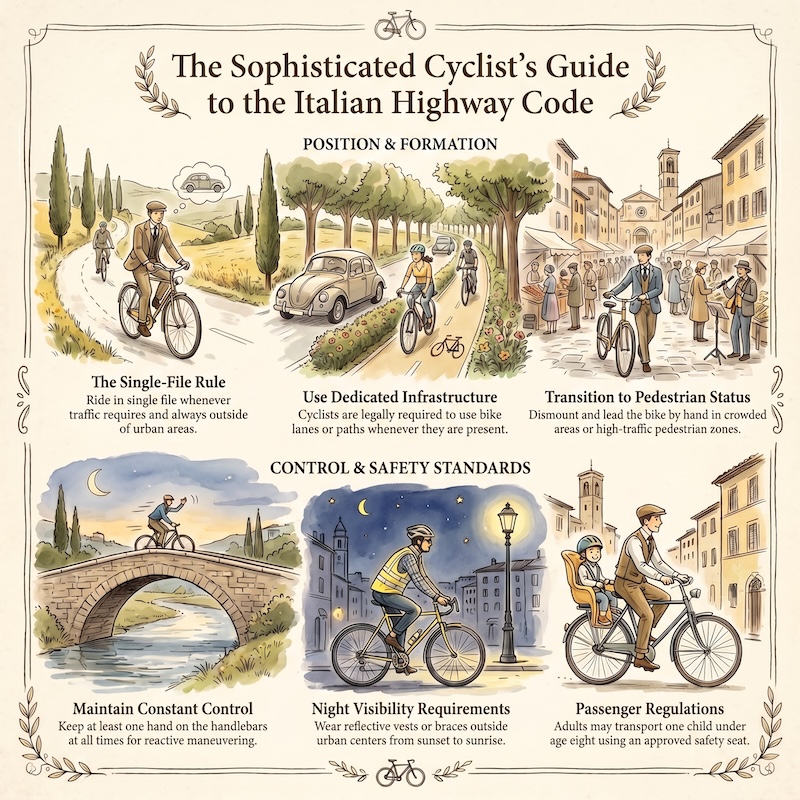
Cyclists must behave in a way that ensures safety both for themselves and for other road users. One of the main rules concerns their position on the road: they must ride in single file whenever traffic conditions require it and, in any case, they must never ride more than two abreast. Outside built-up areas, the rule is stricter, as they must always ride in single file, except when one of them is a child under ten years old, who may ride to the right of the adult.
These limitations do not apply when riding on dedicated infrastructure such as cycle paths, cycle lanes, or shared pedestrian and cycle routes, where cyclists may move more freely while still respecting the specific rules of those areas.
While riding, the cyclist must maintain full control of the bicycle. They must have their hands free and hold the handlebars with at least one hand, so they can react promptly to any situation. It is essential that they can see clearly ahead and to both sides and perform manoeuvres quickly and safely.
It is forbidden to tow vehicles or animals and to be towed by another vehicle. Such behaviour is dangerous because it reduces control and increases the risk of accidents.
When traffic conditions require it, for example in crowded pedestrian areas, the cyclist must get off the bicycle and walk, pushing it by hand. In this situation, they are considered a pedestrian and must behave with the same care and caution.
Carrying passengers is allowed only if the bicycle is specifically designed and equipped for that purpose. However, an adult may carry a child up to eight years old, provided the child is properly secured with a suitable seat or device. There are also bicycles approved for carrying multiple people, but in such cases strict limits apply to the number of passengers.
Regarding circulation, bicycles must use cycle paths or cycle lanes when they are available, except in specific cases. This requirement helps improve safety by separating bicycle traffic from other vehicles.
Visibility is a very important aspect. Outside built-up areas, during nighttime (from half an hour after sunset to half an hour before sunrise) and in tunnels, cyclists must wear a high-visibility reflective vest or braces. This greatly increases their visibility to other road users.
Anyone who does not comply with these rules is subject to administrative penalties. The penalties are higher for bicycles designed to carry multiple passengers, due to the increased risks involved.
For theory exam preparation, it is important to remember that a cyclist is a full road user and must follow specific rules. Safety depends on correct behaviour, respect for others, and proper use of dedicated infrastructure when available.
Studied the theory? Test yourself with 7,000+ official Italian Ministry questions.
📝 Start now with SuperQuizPatente