
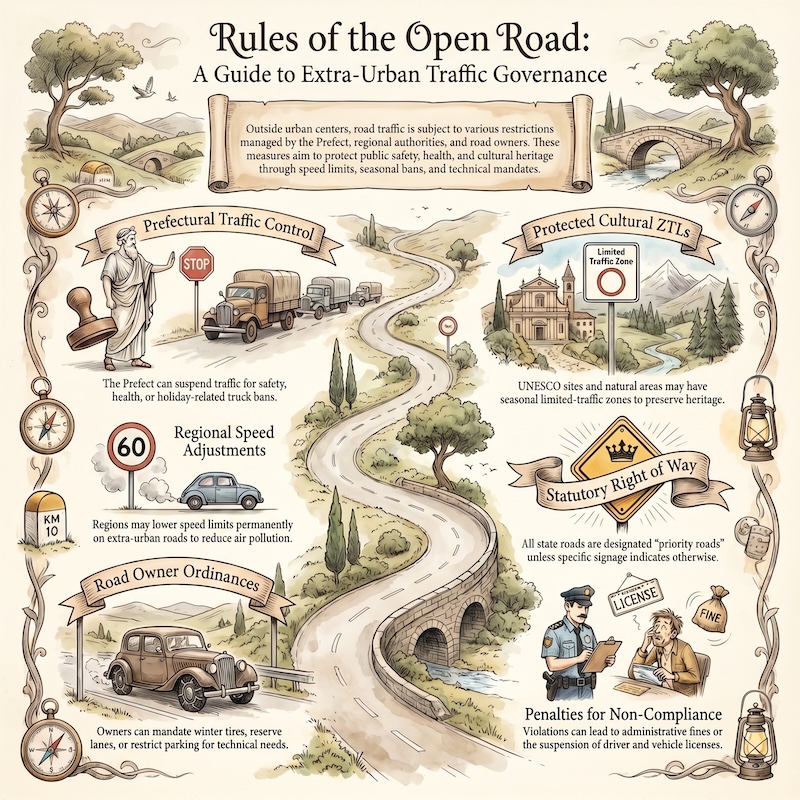
Outside built-up areas, traffic may be restricted, suspended, or regulated for reasons of public safety, road safety, health protection, or other special needs. In some cases, the prefect may temporarily prohibit traffic for all users or only for certain categories of vehicles on specific roads or road sections. On public holidays or other officially designated days, the circulation of vehicles used for transporting goods may also be prohibited, except in the cases specifically allowed.
When it is necessary to reduce air pollution, regions and autonomous provinces may impose lower speed limits, even on a permanent basis, on certain sections of motorways and main extra-urban roads, especially where they pass through or near built-up areas. These limits must be made known to road users through the legal means provided, and compliance may also be checked through automatic systems. Anyone who does not respect these speed limits is subject to the penalties for speeding.
The prefect may also set specific rules for the periodic movement of herds and flocks, indicating, when necessary, the routes, times, and distances to be respected. This is meant to avoid danger and obstruction to traffic.
The road authority may issue ordinances for safety reasons or for technical needs. It may temporarily suspend traffic, impose permanent or temporary prohibitions or restrictions, reserve lanes for certain categories of vehicles, prohibit or limit parking and stopping, or make parking subject to payment. It may also require vehicles to carry anti-skid devices or to use winter tyres suitable for driving on snow or ice.
In the event of heavy snowfall or a concrete safety risk, outside built-up areas the exclusive use of winter tyres may be required when other solutions are not enough to ensure safe traffic. In addition, for technical or cleaning needs, stopping may be temporarily prohibited, but this prohibition must be announced at least forty-eight hours in advance.
In special areas of cultural, landscape, or natural importance, especially those protected by UNESCO, territorial limited traffic zones may be established for limited periods of the year. In these areas, access and circulation may be subject to special restrictions, provided that suitable conditions of safety and traffic flow are also maintained on the roads outside the zone.
Authorities that impose suspensions or traffic restrictions may grant exceptions or permits in cases of serious and proven necessity. These permits may be subject to special conditions, but access to limited traffic zones for authorized categories cannot be subject to payment.
As for priority, all state roads are considered priority roads unless a different rule is established at particular intersections. On other roads, priority is determined by the road authority according to the road classification and must be shown with the proper road signs. When traffic intensity or safety requires it, the road authority may also require drivers to stop before entering a priority road.
Anyone who does not comply with traffic suspensions, prohibitions, limits, or other requirements established for roads outside built-up areas is subject to administrative penalties. In some cases, especially for goods vehicles or when orders given by officers are not obeyed, additional penalties may also apply, such as suspension of the driving licence and vehicle registration document.
Studied the theory? Test yourself with 7,000+ official Italian Ministry questions.
📝 Start now with SuperQuizPatente