
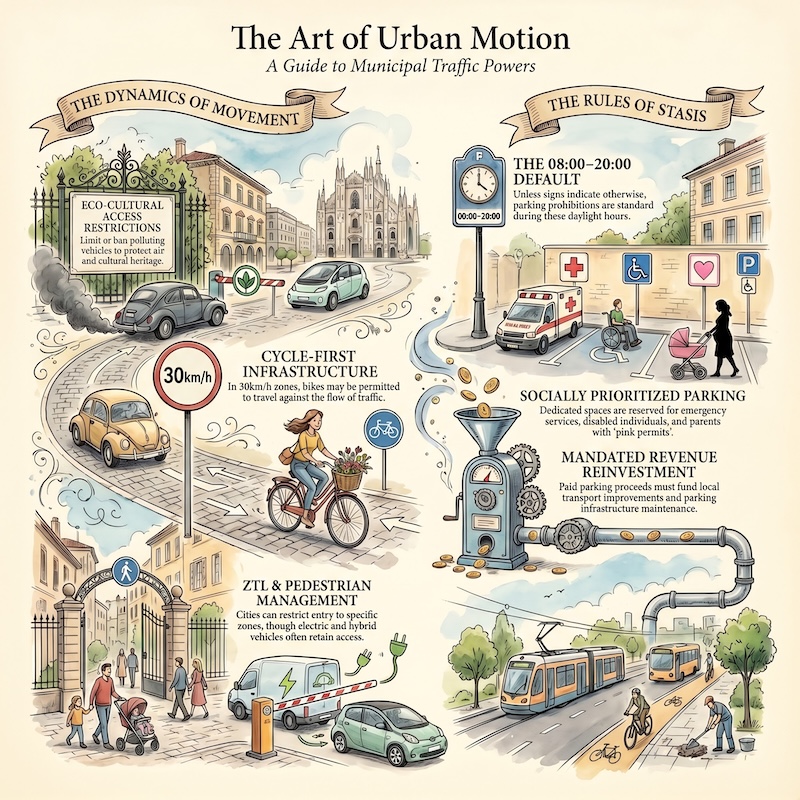
In built-up areas, the municipality may regulate traffic by mayoral ordinance for reasons of safety, health protection, environmental protection, preservation of cultural heritage, and better organization of urban traffic. This means that the municipality may introduce prohibitions, limitations, obligations, and other measures to adapt traffic rules to the needs of the city.
The municipality may restrict the circulation of all vehicles or only certain categories when this is necessary to reduce air pollution and protect cultural heritage, while still taking into account mobility needs and productive activities. In practice, more polluting vehicles may be prohibited or limited in some urban areas, while certain categories of vehicles may be exempt.
In built-up areas, the municipality may also establish priority on specific roads or at certain intersections. When traffic conditions or safety require it, drivers may be obliged to stop and give way before entering a road.
Parking spaces may be reserved for specific categories of vehicles. These include vehicles of the police, fire brigade, and rescue services, vehicles serving persons with disabilities, vehicles serving pregnant women or parents with very young children who hold the special pink permit, electric vehicles or charging spaces for them, vehicles used for passenger drop-off and pick-up or for loading and unloading goods in busy areas, public transport vehicles at terminals, and school transport vehicles during the relevant hours.
The municipality may designate areas where parking is allowed and may also establish paid parking areas or paid lateral parking strips. It may set time slots and spaces reserved for vehicles used for loading and unloading goods, create parking areas for motor caravans, and reserve entire roads or individual lanes for public transport in order to improve urban mobility.
On certain one-way streets, if the speed limit is 30 km/h or lower, the municipality may allow bicycles to travel in the opposite direction through special cycle lanes when it is not possible to create a separate cycle track. At some traffic-light intersections, it may also establish a bicycle waiting area, meaning a space in front of the stop line reserved for cyclists.
If a parking prohibition sign does not indicate otherwise, the prohibition is understood to apply from 8 a.m. to 8 p.m. This is important because, unless another time is shown, this is the standard period to be applied.
For non-municipal roads crossing built-up areas, some decisions still belong to the prefect or to the road authority, while others belong to the municipality, which in certain cases must first hear the opinion of the road owner. This means that not every rule inside a built-up area is always decided only by the municipality.
When traffic suspensions, prohibitions, or limitations are in force, special permits may be granted in cases of proven necessity. Even in cases of parking or stopping restrictions, special permits may be issued, for example to police vehicles, healthcare professionals on duty, and persons with reduced mobility who hold the proper permit.
Parking areas must be located outside the carriageway and must not obstruct traffic flow. If access to the parking area is open to everyone, it is considered public use even if it is paid or controlled by barriers.
Revenue from paid parking cannot be used freely. It must be used for the construction, installation, management, and improvement of parking areas, as well as for financing local public transport and measures to improve urban mobility.
When the municipality establishes paid parking or parking duration control systems, it must normally also provide a suitable nearby area for free or uncontrolled parking. This rule does not apply in pedestrian areas, limited traffic zones, or other particular urban zones where there are special traffic needs.
The municipality may define pedestrian areas and limited traffic zones by considering road safety, health, public order, environmental protection, cultural heritage, and territorial needs. In these areas, vehicle entry and circulation may be prohibited, limited, or made subject to payment. Electric and hybrid vehicles must in any case be allowed free access to limited traffic zones.
Inside limited traffic zones, the municipality may also set a maximum allowed time of stay, which may differ according to the type of vehicle or user. All special zones, such as pedestrian areas, limited traffic zones, and other urban areas with special rules, must be marked by specific road signs.
In limited traffic zones and other urban areas of particular importance, the municipality may reserve parking spaces for residents, either free of charge or for payment. In urban school zones, it may restrict or prohibit circulation, parking, or stopping for some or all categories of vehicles during certain times, except for school buses, vehicles transporting pupils, and authorized vehicles used by persons with disabilities.
The municipality may also define cycle zones, where some categories of vehicles may be limited or excluded, traffic calming measures are applied, and the speed limit may not exceed 30 km/h. These zones are intended to protect cyclists more effectively and make urban traffic safer.
Anyone who does not comply with suspensions or prohibitions of circulation in built-up areas is subject to administrative penalties. Specific penalties are also provided for entering bus lanes, pedestrian areas, or limited traffic zones without authorization, for violating environmental restrictions on polluting vehicles, and for breaching parking rules, including paid parking and exceeding the allowed parking time.
Working illegally as an unauthorized parking attendant is prohibited. Anyone carrying out this activity without authorization is subject to very high penalties and, in more serious cases, also to criminal consequences.
Studied the theory? Test yourself with 7,000+ official Italian Ministry questions.
📝 Start now with SuperQuizPatente