
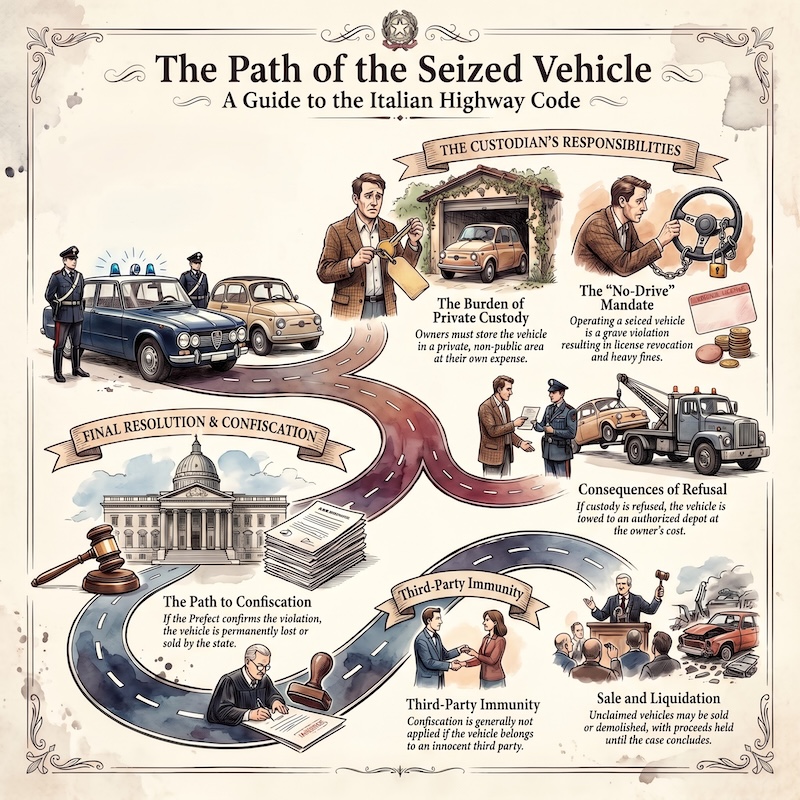
When the Highway Code provides for the administrative confiscation of a vehicle or other items connected to a violation, the police must first proceed with seizure. Seizure is an immediate precautionary measure: it serves to prevent the vehicle from continuing to be used or from being removed before the final decision. The officer must clearly state in the report that the vehicle has been seized.
As a general rule, the owner of the vehicle, or if absent, the driver or another jointly liable person, is appointed as custodian. This means that they must keep the vehicle at their own expense in a private place not open to public traffic, and they must transport it there safely. The vehicle registration document is kept by the police office, and the vehicle must display a visible indication that it is under seizure.
If the person responsible refuses to take custody of the vehicle or fails to transport and store it as instructed, a very high administrative penalty is applied, together with suspension of the driving licence for one to three months. In such cases the vehicle is immediately removed and taken to an authorized storage facility. If the entitled person still does not take custody within the prescribed period and pay the related expenses, the vehicle may be sold, even only for scrapping. The money obtained remains deposited until the end of the proceedings: if confiscation is later confirmed, that money becomes the object of confiscation; if confiscation is not confirmed, the amount is returned to the entitled person.
A custodian of a seized vehicle must never use it or allow anyone else to use it. Driving a seized vehicle is a very serious offence. In that case, a new high monetary penalty applies, the vehicle is immediately removed and transferred to an authorized subject, and revocation of the driving licence may also be applied. For theory exam purposes, it is essential to remember that a seized vehicle must remain unused: using it is a separate and very serious violation.
If, after appeals or after the expiry of the time limits to challenge the measure, confiscation becomes final, the custodian must transfer the vehicle at their own expense to the place indicated by the Prefect. If this is not done within thirty days, the authority arranges the transfer at the custodian’s expense, and there may also be further consequences if the conduct amounts to a criminal offence.
It is possible to appeal the seizure to the Prefect. If the appeal is accepted, the seizure ends and the vehicle must be returned, or, if it had already been sold in the cases allowed by law, the amount obtained must be returned. If the Prefect considers the violation well founded, the seizure is confirmed and confiscation may be ordered either in the payment order or in a separate decision.
Confiscation means the definitive loss of the vehicle or, if the vehicle has already been sold, of the amount obtained from the sale. In addition, the confiscation order also serves as an enforceable title for recovering transport and custody expenses. The order is then communicated to the public registers for official annotation.
An important principle is that confiscation does not apply if the vehicle belongs to a person unrelated to the administrative violation. However, the law always provides for confiscation when the vehicle has been used to commit a criminal offence different from those provided for in the Highway Code, whether the driver is an adult or a minor.
Studied the theory? Test yourself with 7,000+ official Italian Ministry questions.
📝 Start now with SuperQuizPatente