
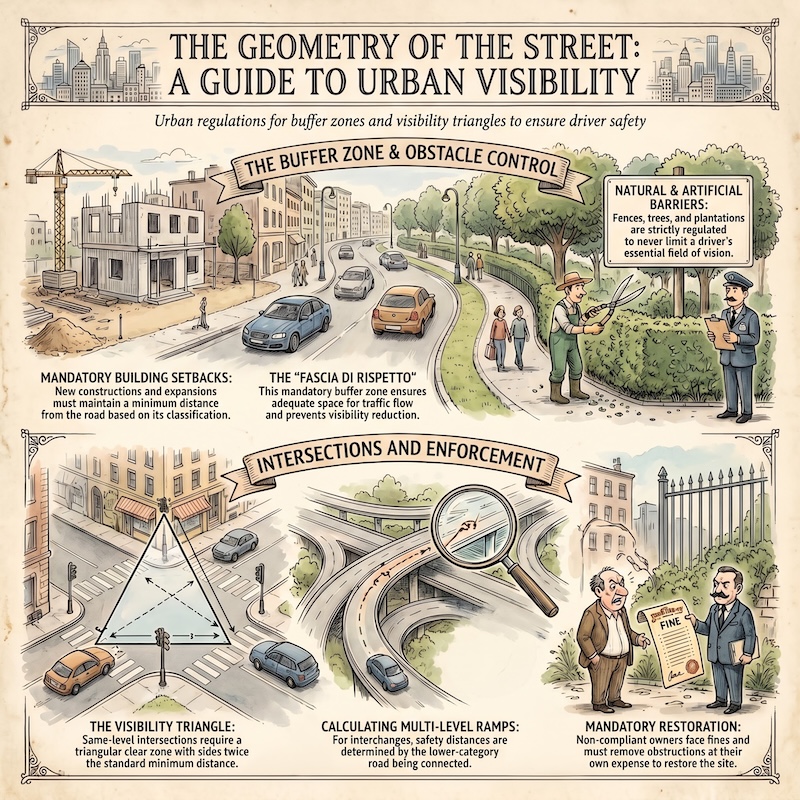
In urban areas, when constructing new buildings, reconstructing existing ones, or extending them, it is mandatory to maintain a minimum distance from the road. This distance, called a safety zone, is designed to ensure road safety and depends on the type of road. Building too close to the roadway can reduce visibility and increase risks for road users.
At intersections at the same level, in addition to these safety distances, a visibility area must also be kept clear. This area has a triangular shape and is essential for allowing drivers to clearly see approaching vehicles from other directions. The sides of this triangle extend along the edges of the roads, and their length is determined based on the type of road, usually equal to twice the required minimum distances. This space must remain free of obstacles such as buildings, walls, trees, or other objects.
At grade-separated intersections, such as junctions or interchanges, it is forbidden to build any elevated structures that could interfere with safety or the proper functioning of the intersection. In these cases, the required distances along ramps are based on the lower-category road involved.
Fences, trees, and vegetation must also be designed in a way that does not obstruct visibility. They must comply with urban planning rules and must not reduce the field of vision needed for safe driving.
Anyone who violates these rules is subject to an administrative fine and must restore the area to its original condition at their own expense by removing any non-compliant structures or obstacles.
Studied the theory? Test yourself with 7,000+ official Italian Ministry questions.
📝 Start now with SuperQuizPatente